
The honest field guide to the QuickSwap exchange
Everything you actually need to know about QuickSwap, the leading decentralized exchange (DEX) on Polygon — written by long-time DeFi users, not a marketing team. We explain how it works, what it really costs, and where the risks hide.
Not the official QuickSwap site This is an independent educational guide. We are not affiliated with QuickSwap, Polygon or CEX.IO. The official DEX is at quickswap.exchange — always verify links before connecting a wallet.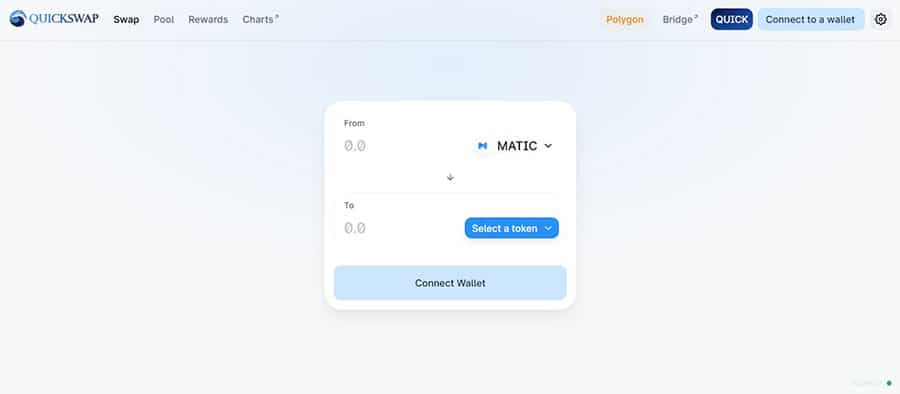
*Figures cited from the official QuickSwap website, its documentation and public analytics (e.g. DeFiLlama). They change frequently — treat them as a snapshot, not a guarantee, and verify at the source.
What is the QuickSwap exchange, in plain English?
QuickSwap is a decentralized exchange (DEX) — a set of smart contracts that lets you swap one crypto token for another without a company holding your money in between. It launched in 2020 as the flagship DEX on Polygon, the popular Ethereum scaling network, and built its reputation on swaps that cost a fraction of a cent instead of the eye-watering gas fees of Ethereum mainnet.*
Here is the part the marketing pages gloss over: QuickSwap is not a company you sign up with. There is no email, no password, no account balance held on a server. When you "use QuickSwap," your own wallet signs a transaction that talks directly to the contracts on Polygon. Nobody at QuickSwap takes custody of your funds along the way. Internalise that one sentence and you have already avoided the most expensive beginner mistakes.
The project brands its wider ecosystem as "DragonFi" — hence the dragon logo and product names like Dragon's Lair and Dragon's Syrup. Our job here is not to repeat the brochure; it is to stress-test it for you and translate the jargon into something you can act on.
QuickSwap = a non-custodial DEX on Polygon. Swap tokens, provide liquidity to earn fees, stake QUICK for rewards, and trade perps — all by connecting a self-custody wallet. There is no email signup and no customer-support safety net. Cheap, fast, and entirely your responsibility.
First principle: custodial vs non-custodial (read this twice)
Nine out of ten expensive beginner mistakes come from confusing these two models. So let's be blunt about it.
A centralised exchange (CEX) — Binance, Coinbase, Bybit, CEX.IO — is like a bank. You create an account with an email and password, pass identity checks (KYC), and the platform holds your coins. Forget your password? Support can help you back in. The trade-off: you are trusting them with your funds, and they can freeze your account.
A non-custodial DEX like QuickSwap — accessed through a wallet such as MetaMask or Trust Wallet — is like a personal safe only you can open. You hold the keys: a 12- or 24-word seed phrase. There is no password reset, because there is no password and nobody to reset it. Lose the seed phrase, or sign a malicious transaction, and the funds are gone. Full stop.
If a website or "support agent" offers to recover your QuickSwap account by email, chat or phone, it is a scam. Real DeFi has no such button. Your seed phrase is the account.
Neither model is universally "better" — they're tools for different jobs. Plenty of experienced users keep a regulated CEX account for buying, selling and cashing out to a bank, and a self-custody wallet for actually interacting with protocols like QuickSwap. We'll come back to that workflow below.
The QuickSwap product stack, audited honestly
QuickSwap is more than a swap box. Here's what each part does — and the catch with each.
Swap (the DEX)
Trade any supported token for another in a single on-chain transaction. Catch: on thin (low-liquidity) pairs you can suffer slippage, and a careless slippage setting invites MEV "sandwich" bots.
Pools & liquidity
Deposit a pair of tokens to earn a share of trading fees. Catch: impermanent loss is real — if prices diverge you can end up worse off than simply holding.
Dragon's Lair / Syrup
Stake QUICK to earn protocol rewards (dQUICK), or farm other tokens in Syrup pools.* Catch: advertised APRs are variable and can collapse as more capital arrives.
Perps & limit orders
Perpetual futures with high leverage and DCA/limit orders via integrated partners.* Catch: leverage is the fastest way to liquidate your account; treat it with extreme caution.
Why Polygon? The whole point of QuickSwap
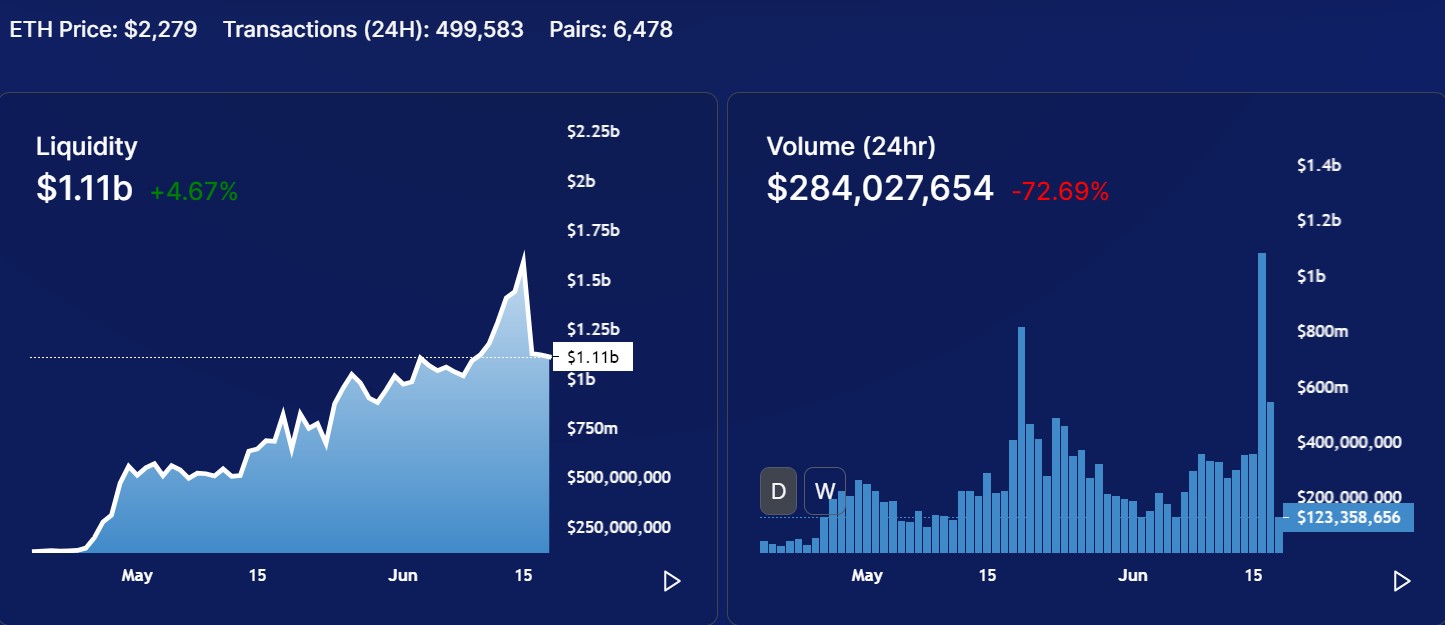
QuickSwap exists because Ethereum mainnet got expensive. Polygon is a scaling network that settles to Ethereum but processes transactions far more cheaply. On QuickSwap, a swap that might cost $10–$50 in gas on Ethereum typically costs a fraction of a cent. That single fact reshapes behaviour: you can rebalance, experiment and make small trades without gas eating you alive.
QuickSwap has since expanded beyond Polygon PoS to Polygon zkEVM and several other EVM chains.* But Polygon remains its heartland, and "QuickSwap = the Polygon DEX" is still the most accurate one-liner.
Mature, cheap, battle-tested — but it's still DeFi
QuickSwap is one of the longest-running DEXs on Polygon with deep liquidity on major pairs. The technology is solid and fees are tiny. We dock points only for the inherent risks every DEX shares: smart-contract exposure, self-custody responsibility, and the phishing ecosystem that targets all of crypto.
Fees & networks: where the money quietly leaks
Two completely different cost layers, and beginners conflate them:
| Cost | Who you pay | Typical range | How to reduce it |
|---|---|---|---|
| Network gas | The blockchain (validators) | A fraction of a cent on Polygon; far more on Ethereum mainnet | Trade on Polygon; avoid bridging back to Ethereum unless necessary |
| Swap fee (V2) | The protocol / liquidity providers | ~0.25% per swap* | Trade liquid pairs; mind the cumulative cost of many small swaps |
| Swap fee (V3) | Liquidity providers | Dynamic, pair-dependent* | V3's dynamic fee adapts to volatility — usually competitive on deep pairs |
| Slippage / MEV | The market | ~0% on deep pairs; painful on thin ones | Set a sensible slippage cap; split large orders |
The single most expensive beginner error isn't a QuickSwap fee at all — it's sending tokens on the wrong network when moving funds between an exchange and your wallet (for example, withdrawing as ERC-20 to a Polygon address, or vice-versa). The sending and receiving networks must match exactly. There is no undo button on the blockchain.
How to get started safely (the boring, correct way)
This is the workflow we'd give a friend. It deliberately separates "buying crypto" from "using a DEX," because mixing the two is where people get hurt.
Get a self-custody wallet
Install a reputable wallet (MetaMask, Rabby, or a hardware wallet like Ledger for larger sums) and add the Polygon network. Write the seed phrase on paper — never in a screenshot, cloud note or chat. See our QuickSwap wallet guide.
Get some crypto — and a little MATIC/POL for gas
Many people buy on a regulated exchange first, then withdraw to their wallet on the Polygon network. You need a tiny amount of the native gas token to transact. A converter such as CEX.IO Convert can simplify first swaps with fixed quotes.
Reach the real app — verify the URL
Go to the official quickswap.exchange and follow its link to the app. Bookmark it. Most DeFi thefts start with a fake link in an ad or DM, not a protocol bug. See our QuickSwap app guide.
Connect, start tiny, read every signature
Connect your wallet, do a small test swap first, and actually read what each transaction approves. Revoke stale token approvals periodically. Our login guide walks through it.
The risk register nobody puts on the homepage
- Smart-contract risk. Audits reduce risk; they don't eliminate it. Newer code (e.g. a fresh integration) carries more unknowns than battle-tested contracts.
- Impermanent loss. Providing liquidity is not free yield — divergent prices can leave you worse off than holding. Understand it before you deposit.
- Phishing & approvals. The most common loss vector by far. A single malicious "approve" signature can drain a token balance. Fake QuickSwap sites buy ads — verify the domain every time.
- Leverage / liquidation. Perps with high leverage can wipe a position in seconds. Most people should avoid them entirely.
- Regulatory shifts. Frameworks like the EU's MiCA keep evolving and may change what's available in your region.
QuickSwap (DEX) vs a centralised exchange: when to use which
| QuickSwap (non-custodial DEX) | Centralised exchange (e.g. CEX.IO) | |
|---|---|---|
| Who holds funds | You (your keys) | The platform |
| Sign-up | Connect a wallet, no KYC | Email + ID verification |
| Recover access | Only via your seed phrase | Support can help |
| Best for | On-chain swaps, LP, farming, Polygon-native tokens | Buying with card/bank, cashing out, simple swaps |
| Main risk | Self-custody mistakes, contract bugs | Counterparty / platform risk |
Our honest recommendation for newcomers: use a regulated CEX to turn cash into crypto and learn the ropes, then graduate to a self-custody wallet and QuickSwap once you genuinely understand seed phrases and network selection. Skipping that learning curve is how money gets burned.
Your seed phrase is the master key to everything. Never type it into a website, never share it, never store it online. Anyone who has it owns your funds — instantly and irreversibly.
A short history: how QuickSwap became the Polygon DEX
To judge a protocol, it helps to know where it came from. QuickSwap launched in 2020 as one of the first major automated market makers on Polygon (then branded Matic Network).* Its pitch was blunt and effective: take the Uniswap model everyone already understood, and run it somewhere transactions cost a fraction of a cent. As Polygon's user base exploded through 2021, QuickSwap rode that wave to become the network's flagship exchange — the default place to trade Polygon-native tokens.
The years since have been a story of expansion and reinvention rather than reinvention for its own sake. The team rebranded its ecosystem as "DragonFi," ran the 1:1000 QUICK token migration to make the per-token price friendlier, shipped a V3 built on the Algebra concentrated-liquidity engine, added perpetual futures through partners, and extended beyond Polygon PoS to Polygon zkEVM and other EVM chains.* That longevity matters: in a sector where protocols routinely vanish, a DEX that has operated continuously for years through multiple market cycles has earned a degree of (cautious) trust that a three-month-old fork simply hasn't.
The DragonFi ecosystem at a glance
"DragonFi" is QuickSwap's umbrella term for its suite of products. You don't need to memorise the branding, but knowing the map helps you navigate the app:
| Name | In human terms | Our guide |
|---|---|---|
| The DEX (Swap) | Trade tokens directly from your wallet | App guide |
| Dragon's Lair | Single-stake QUICK to earn fee revenue (dQUICK) | QUICK token |
| Dragon's Syrup | Stake to earn partner tokens over time | QUICK token |
| V3 pools | Concentrated-liquidity LP with dynamic fees | QuickSwap V3 |
| Perps | Leveraged futures via an integrated partner | App guide |
Each of these gets its own deep-dive on this site. The thread connecting them all is the same first principle we opened with: you interact with every one of them from a wallet you control, and no part of the system ever takes custody of your funds.
Five myths about QuickSwap, debunked
- "QuickSwap is a company that holds my money." No — it's a set of smart contracts. Your funds live in your wallet and on-chain, never on a QuickSwap server.
- "There's an official QuickSwap app to download for trading." The core DEX is a website you use through a wallet. Be wary of anything in an app store claiming otherwise.
- "Staking QUICK is guaranteed income." Rewards are real but variable, and the token's price can fall faster than yield accrues.
- "Providing liquidity is free money." Impermanent loss is a genuine cost that can leave you worse off than holding.
- "Support can recover my funds if I get hacked." There is no support desk with that power. Self-custody means self-responsibility.
If you take one thing from this homepage, make it this: QuickSwap is a powerful, mature, genuinely cheap way to trade on Polygon — and it hands you the keys and the liability in equal measure. The rest of this guide is about helping you carry that liability without getting hurt.