
The QUICK token, decoded — utility, staking & the migration nobody explains
QUICK is the token at the centre of QuickSwap's 'DragonFi' ecosystem. Here's what it actually does, why old price charts confuse everyone, and how staking really works — minus the hype.
Not the official QuickSwap siteThis is an independent educational guide. We are not affiliated with, endorsed by, or operated by QuickSwap, Polygon, or CEX.IO. The official DEX lives at quickswap.exchange — always verify links before connecting a wallet.What QUICK is — and what it isn't
QUICK is the native token of QuickSwap. In the project's own framing it powers "DragonFi": it's a governance token (vote on proposals) and a rewards token (stake to earn a slice of the fees the protocol generates).* What it is not: a share of a company, a promise of profit, or a savings account with a guaranteed yield. Treat any "QUICK will 100x" content with deep suspicion.
The 1:1000 migration that confuses everyone
If you look at an old QUICK price chart you might see a figure in the thousands of dollars, then a sudden "crash" to a few cents. That was not a collapse — it was a deliberate token migration. QuickSwap converted the original QUICK into a "new QUICK" at a ratio of 1:1000, increasing the supply and lowering the per-token price so it felt more accessible to newcomers.* Your total value wasn't diluted by the split itself; you simply held 1,000× more tokens at 1/1000th the price.
When you read price history, market cap or "all-time high" stats for QUICK, check whether the figure is pre- or post-migration. Comparing an old per-token price to today's is meaningless. Always look at fully-diluted value and circulating supply, not just the sticker price of one token.
The real utility, audited
- Governance. QUICK is used to signal and vote on protocol decisions (often via snapshot-style voting).* Influence scales with how much you hold/stake.
- Fee sharing via staking. Stake QUICK in Dragon's Lair to receive
dQUICK, a receipt token that accrues a share of trading fees over time.* - Rewards & incentives. QUICK is used to bootstrap liquidity — farms and Syrup pools distribute it (or let you earn other tokens) to attract capital.*
Notice what's missing from that list: any mechanism that guarantees the price goes up. Utility tokens can have genuine demand drivers and still fall in price. Both things are true at once.
Dragon's Lair staking, in plain terms
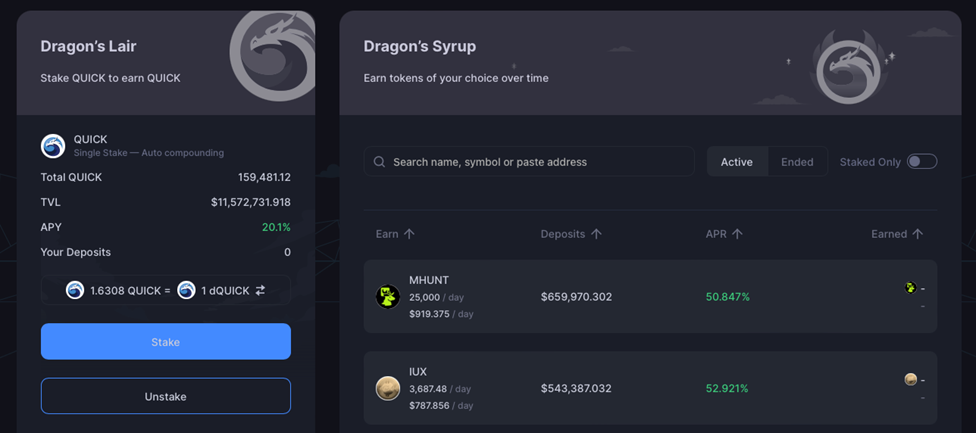
Dragon's Lair is QuickSwap's single-asset staking vault. You deposit QUICK and receive dQUICK in return. As the protocol collects fees, the value of each dQUICK relative to QUICK is designed to grow, so when you unstake you get back more QUICK than you put in (assuming positive fee flow).* It's "auto-compounding" in spirit — you don't have to claim rewards manually.
Real mechanism, but mind the variable APR
Dragon's Lair is a legitimate fee-sharing design, not a Ponzi. But advertised APRs swing with volume and total staked, and a token's price can fall faster than yield compensates. Stake because you believe in holding QUICK, not because a big APR number caught your eye.
How to get QUICK (without burning money)
Get crypto onto Polygon
Buy on a regulated exchange and withdraw to your wallet on the Polygon network, or bridge from another chain. Keep some MATIC/POL for gas.
Verify the QUICK contract
Before swapping, confirm the official QUICK contract address from a trusted source. Fake "QUICK" tokens exist specifically to trap careless buyers.
Swap on QuickSwap
Use the Swap tab to trade, say, USDC for QUICK. Start small, check price impact, confirm.
Tokenomics & the honesty check
Before you buy any token, ask the boring questions the marketing won't volunteer:
| Question | Why it matters |
|---|---|
| Circulating vs total supply | A low circulating supply with big future unlocks can pressure the price as tokens release. |
| Emissions / inflation | If new QUICK is minted faster than demand grows, rewards can dilute holders. |
| Where does yield come from? | Real fee revenue is sustainable; pure token emissions are not. |
| Liquidity depth | Thin liquidity means slippage when you eventually sell. |
We're not going to quote a live price or market cap here, because it would be stale by the time you read it. Check current, post-migration figures on reputable analytics and the official app — and weight on-chain fee revenue more heavily than headline APRs.
Risks, stated plainly
- Price volatility. QUICK can fall sharply and has done so before. Only allocate what you can afford to lose.
- Smart-contract risk. Staking contracts are audited but never risk-free.
- Variable rewards. APRs are not promises; they move with usage.
- Lookalike scams. Fake QUICK tokens and fake staking sites are common — verify everything.
A token's "APR" is never a guarantee, and your staked QUICK is only as safe as your seed phrase. Back it up offline and verify every contract address.
Governance in practice: what voting actually does
"Governance token" sounds grand, so let's ground it. In practice, holding QUICK lets you participate in decisions about how the protocol evolves — things like which farms get incentives, how treasury funds are used, or parameter changes. Voting is often conducted through snapshot-style polls where your weight reflects your holdings or staked balance.* Be realistic about this: in most DeFi protocols, a small number of large holders carry the bulk of voting power, and turnout among ordinary holders is low. Governance is a genuine feature, but it's not the same as control. Value the token for its fee-sharing and ecosystem role first; treat governance as a bonus rather than the headline.
QUICK versus other DEX tokens
QUICK belongs to a family of "DEX governance tokens" that includes the likes of UNI, CAKE and SUSHI. They share a basic template — govern the protocol, sometimes share fees, incentivise liquidity — but differ in the details that matter:
| Dimension | What to compare |
|---|---|
| Fee capture | Does staking actually route real trading fees to holders, or only token emissions? |
| Emissions schedule | How much new supply is minted, and is it slowing over time? |
| Home network | QUICK is Polygon-native; that ties its fortunes to Polygon's overall traffic. |
| Track record | Years of continuous operation count for something in a high-mortality sector. |
We're deliberately not crowning a "winner." Each token's value depends on the volume its DEX actually does and how much of that flows back to holders — numbers you should check live rather than take on faith from any guide, including this one.
Bonds, Syrup and other mechanisms
Beyond simple staking, the ecosystem has experimented with mechanisms like bonds (buying QUICK or LP tokens at a discount in exchange for a vesting period) and Dragon's Syrup pools (stake to earn a partner project's token rather than QUICK).* These can be useful, but they add complexity and lock-up risk. A discounted bond isn't a free lunch if the token falls during the vesting window, and a juicy Syrup APR in some new token is only as good as that token's liquidity when you try to sell. Read the specific terms, and value rewards in assets you'd actually want to hold.
How to evaluate any reward program (a reusable checklist)
This framework works for QUICK and for every other "earn" product you'll ever meet:
- Where does the yield come from? Real fees from real users are sustainable. Pure emissions of a new token are a countdown, not an income.
- What's the lock-up? Can you exit instantly, or are you committing for days/weeks? Locked funds can't run from a falling market.
- What are you actually paid in? A 200% APR paid in an illiquid token you can't sell is often worth less than a modest yield in a blue-chip asset.
- What's the smart-contract risk? More moving parts means more attack surface. Audits help; they don't guarantee.
- Does the APR assume the token price holds? Most advertised APRs quietly do. If the token drops 50%, the "yield" may not save you.
A quick word on taxes and record-keeping
Boring but important: in many jurisdictions, swapping tokens, earning staking rewards and harvesting farm yields can all be taxable events. Because everything is on-chain and public, the records exist whether you keep them or not — so keep your own. Note dates, amounts and values when you transact. We're not tax advisors and this isn't tax advice; the point is simply that "I forgot to track it" is not a position you want to be in at filing time. As regulation tightens worldwide (the EU's MiCA framework being a 2026 example), clean records are increasingly worth the small effort.
How to research QUICK on-chain (don't trust, verify)
One of the quiet superpowers of crypto is that you don't have to take anyone's word for the numbers — the data is public. Before you act on any claim about QUICK, learn to check it yourself:
- Block explorer. Look up the QUICK contract on a Polygon explorer to see total supply, holder distribution and transfer activity. A handful of wallets holding most of the supply is a yellow flag worth knowing about.
- Analytics dashboards. Sites like DeFiLlama and similar trackers show QuickSwap's real trading volume, total value locked and fee revenue.* Compare advertised APRs against the actual fees the protocol generates — if the maths doesn't add up, the yield is coming from emissions, not users.
- The official docs. Tokenomics, emission schedules and contract addresses should all be documented officially. Cross-reference any figure you see in a tweet against the source.
This habit — "don't trust, verify" — is the difference between investing and gambling. It takes ten minutes and it's the single most valuable skill this entire guide can give you. Any token, including QUICK, should be able to withstand that scrutiny; if checking the on-chain reality makes you less comfortable, that discomfort is information.